Showing posts with label flowers. Show all posts

Monday, October 19, 2015

Still here...

It has been a while since my last update. I'm still alive, as are most of the plants. A move of house - which we now own rather than rent - moving the green house and a change of jobs has rather cut into my "free time"; my orchid exploits - and this blog in particular - have suffered as a result.

Speaking of moving, Senior Management and two of our friends nearly died moving the greenhouse in about 7 pieces back in February - the roof in one giant section was a particular challenge, as it had to be taken around the house on its side, making it rather unwieldy (no photographic evidence, as all hands were needed elsewhere!). Fortunately, we only had to walk it a grand total of a single property line over. A massive ivy "fence" was demolished between the properties, and a precast wall put in its place; we took advantage of that activity to move the greenhouse and plants without going "the long way around". I bought a modular greenhouse in part because of being a renter - I hadn't expected to move less than a year after putting up a greenhouse, but the rent became unreasonable and a good offer to buy came up... Still, moving a greenhouse is quite an operation!

The orchids spent several months under deep shade, being very infrequently watered whilst the greenhouse was moved, and the basic connections were hooked up (power, water), and the backlog of "most urgent" DIY for human habitation was completed. Once the greenhouse was more or less up, I neglected to erect adequate shading, and some of the plants have really taken some strain lately (particularly things like Phalaenopsis that do not enjoy full sun as we move towards spring/summer down here). I predict some casualties. Another more minor "catastrophe" was hooking up misting without fans in place; some plants rotted away seemingly overnight. It's surprising what just a few days of changed weather, neglect or poor cultural conditions can do to a plant. (On the other hand, it's impressive how tough some other plants are!). Usually, it's too much of something that seems to kill orchids; they're seemingly often naturally quite resilient to shortages.

I've also been encountering more pests. Things are wholesale eating my plants, or chunks of them; for example, my Onc. Sharry Baby has had its latest pseudobulb firmly chomped, but it's still soldiering on (it's just started to spike); the Laelia sincorana f. coerulea which I have waited for YEARS (since March 2011) to flower threw out a spike this month (clearly it enjoyed the massive increase in light and neglect). Something ATE IT. I strongly suspect molluscan activities (slugs and snails) and must deploy counter-measures!
Onc.Sharry Baby 'Sweet Fragrance' with slug/snail damage.
Laelia sincorana f. coerulea - first bloom - EATEN!
It's not all bad news of course; some things have quite enjoyed life; our Vanda flowered for only the second time, and some other light-loving plants have also put on quite a show.
Vanda Manuvadee "Blue" - second flowering; October 2015.
This won the first prize in the "Other" orchid category at the recent
Grahamstown Flower Festival Facebook (but not best orchid on show).
Having slowly learnt a little of what orchid judges look for,
I can see the "faults" (compare it to a really flat, round Vanda like one of the
"Roberts Delight" range). It's an old hybrid, so a lot has happened since. 
It's grown quite a lot since I first got it.
Compare the size when it was bought and when it last flowered
Going through my cellphone camera gallery, there are quite a lot of stories to come! Watch this space...

Monday, February 10, 2014

Stanhopea whittenii - first blooms

Back in October 2011, I received three small Stanhopea plants as part of an order from Plantae. They've been quietly growing away for the past couple of years. One of them has finally decided to do something "useful" and put out some flowers!

The particular species that has assented to put on a show is Stanhopea whittenii, which is apparently fairly closely related to Stanhopea oculata. Primary differences are in the number of flowers (2-3 as opposed to many more), the shape of the flower and the scent. It was only described just over a decade ago, in 2002.

Speaking of scent, ours (to my nose) smells like menthol-vanilla, particularly heavy on the vanilla, perhaps with a touch of cinnamon. It's mounted quite far above head height, so I've only caught whiffs of it here and there, rather than my usual method which involves a deep inhale right into the flower!

Stanhopea are all very fragrant orchids. Their scent is a cunning ploy to attract their pollinators, a group of tropical bees called Euglossine bees, sometimes commonly known as "orchid bees" for this behaviour. The males of these bees seek out various strongly scented substances to impress their females - I guess it's the bee equivalent of a nice Eau de Cologne, except instead of buying a bottle, you have to zoom around the forest gathering your own essential oils first! These mostly solitary bees are generally spectacular metallic colours, in green, blue and gold livery; they also commonly visit Catasetum, which I covered briefly in my previous post. These chemicals are, for the most part (but not always), quite pleasant to humans too, and Stanhopea generally produce them in copious, room-filling abundance. Almost all of these orchids flower by sending a spike downwards (through the potting medium); for this reason, they're almost always grown in baskets of various sorts, or mounted, so this flowering habit can be accommodated. If you have the room, and suitable cultural conditions, they're well worth the effort.

In terms of cultural conditions, apparently they like "breezy" conditions, and [very (>3000 foot candles, no direct sun)] bright light - perhaps the move outdoors into severe winds covered the "breezy" part of their cultural preferences, and the light certainly increased; being outdoors, I tend to water more - and moisture is a key part of their cultural needs... Sadly, the flowers are typically short lived (typically in the region of only three all too short days) but in that time they certainly pump out some fragrance!

The best article I found on this species is here, and covers its discovery and naming and has various additional pictures and information on distribution; IOSPE has a page too as does Wikipedia. The genus Stanhopea and the derivation of its name is extensively covered here. Cultural information is covered here and here. Essence of Stanhopea is an orchid blog from Australia that covers this genus extensively.

Pictures, I hear you cry? Certainly!

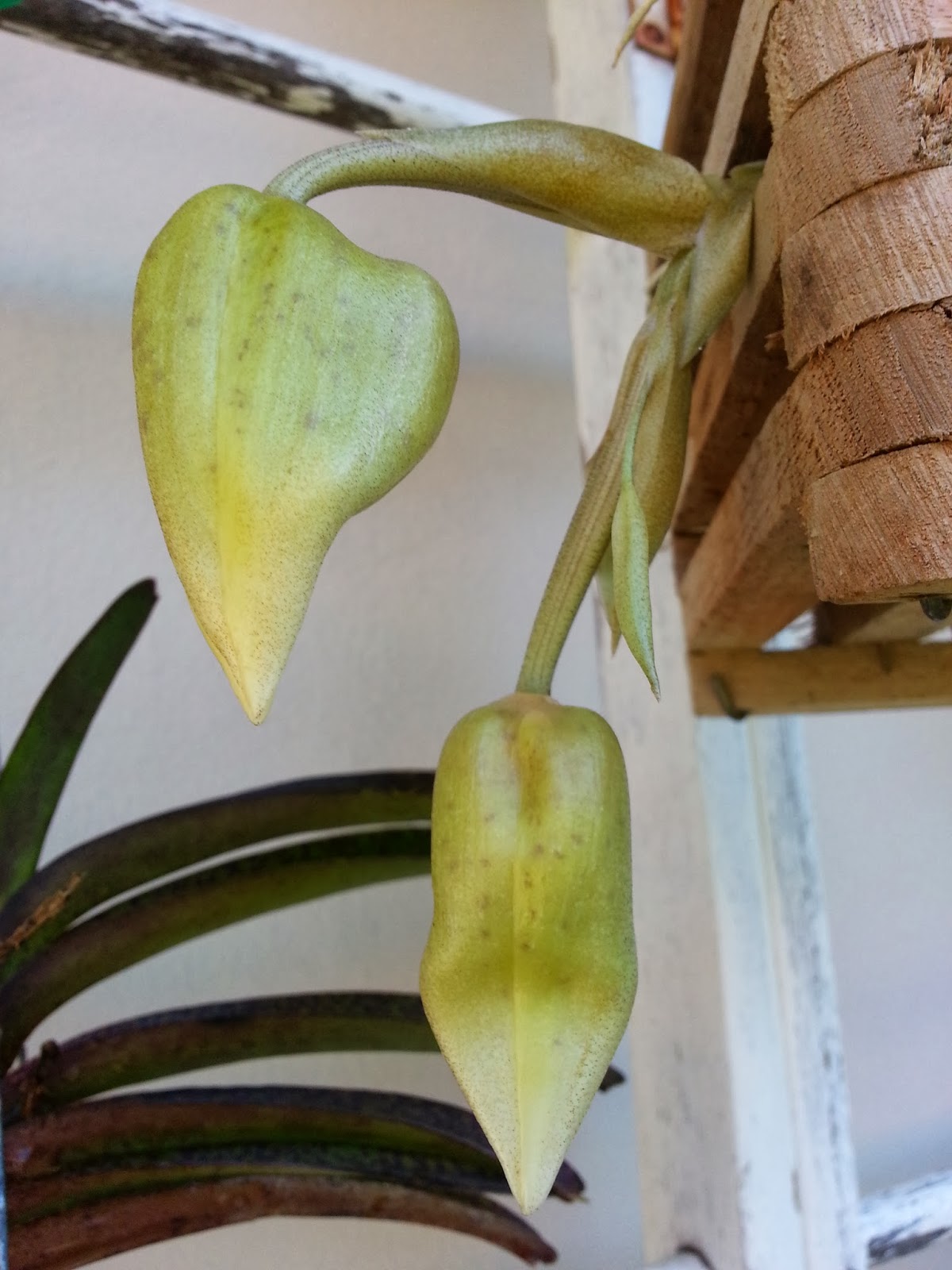
Stanhopea whittenii plant and buds
Stanhopea whittenii buds, 5/2/2014
You can see it gets some morning sun, but is protected for the rest of the day by the roof and garage.
Stanhopea whittenii buds
Stanhopea whittenii buds - two days later (7/2/2014)
Stanhopea whittenii flowers
Stanhopea whittenii
Two days later they opened
(this is from today [10/2/2014], the day after they first opened) 
Stanhopea whittenii flowers
Stanhopea whittenii
You can clearly see the big black blotches that might have confused people into classifying these as Stanhopea oculata.
Stanhopea whittenii flowers
Stanhopea whittenii
View from underneath
Stanhopea are sometimes known as "upside down" orchids as their flowers usually face downwards
Stanhopea whittenii flowers
Stanhopea whittenii
lateral view
Pictures from cellphone camera.

Tuesday, March 6, 2012

New spikes and flowers

Things are definitely deciding to bloom again.
Dendrobium Mini (White with Red Lip)
Our Dendrobium Mini has not one, not two but three separate flower spikes - pictured above is one of them. They're getting longer every day and the buds are starting to take shape now.

Even one of our two cymbidiums has had enough of sitting around doing nothing and is busy putting up two spikes. I have no idea what has triggered that, as I understand it usually takes cooler temperatures to trigger it, and it's been boiling hot around here, but I generally find that plants don't actually spend a lot of time reading books and sometimes resolutely resist such conventions! Given a few weeks, I suspect we'll see some flowers, but you never quite know when an orchid is going to be showing its blooms (at least, I never do!). I'd been starting to think that our little balcony just doesn't get enough light for these plants which have remained fairly unexciting grassy looking houseplants for quite some time now, but it seems - at least on that windowsill - there is just about enough! I wonder if it might be having a bit more water (Cymbidiums apparently quite like to be kept on the damp side), as it receives the run-off from a Vanda that sits above it and is regularly sprayed.

Our Stenoglottis Ganymede also has two spikes on it:

Stenoglottis Ganymede
Flowers beginning to open.
Stenoglottis Ganymede
If last year is anything to go by, this flower spike will get at least three or four times this length and be covered in blooms.

Towards the end of last year, I received an Aerangis citrata from Plantae which had two spikes on it; the flowers are now starting to open.
Aerangis citrataFirst flower to open.
Aerangis citrata
Aerangis citrata
showing spur
I really enjoy the angraecoid orchids, which have a delicate and graceful elegance to them (at least, I think they do!). I haven't detected a scent to this one but I have yet to sniff it in the evenings, when this group is usually most strongly scented. The flower has a very slight yellowish tint to it (hence the botanical name, I suspect) which isn't coming through in these photos very well.

Friday, March 2, 2012

Stelis ?vulcanica? - surprise flowering

Usually I notice when plants throw out a spike - I tend to watch them like a hawk for any signs of interesting growth. Well, actually, I doubt hawks look at their orchid collections much, so I watch them like any (obsessive?) orchid-grower watches their plants... Somehow, I missed this one that sprung up in between several leaves that had grown on top of each other; I was having a look at the plant and noticing several other promising-looking growths on the leaves, and then this spike peeped out at me, in full bloom!
Stelis nanegalensis
Stelis nanegalensis
For those of you who just like the pretty pictures, stop reading now. Beyond this point Taxonomy Alert!

I obtained this plant, labelled Stelis vulcanica, last year; it appears not to be a valid name (RHS says it should be Stelis nanegalensis), but this name still seems to be commonly used. It's also possible that this is mis-identified. We first saw a "Stelis vulcanica" at an EPOS meeting last year (the first one Senior Management and I attended together, I think); someone noted (when the plant table was being discussed) that vulcanica wasn't valid and suggested it was perhaps argentata, but it seems they probably actually meant nanegalensis! In any case, Senior Management expressed the opinion that such a plant should be encouraged to appear at OOAB, so this was duly accomplished.

Anyone have a handy (up-to-date) monograph on Stelis, preferably with keys?

http://speciesidentificationtaskforce.blogspot.com/2010/07/additional-information-stelis.html has some scans of various books that are somewhat helpful; one of the references notes that argentata has a small hook on the lip of the flower, which this flower has (zoom in on the full size versions, or see crop below); at the same time, there is a nice botanical illustration of nanegalensis which clearly also shows such a "tooth". It's possible one of the authors got this wrong (such a thing is not unheard of). At the same time, I'm an absolute neophyte at plant taxonomy, so I could be totally mistaken. To me, this looks most like Luer's illustration of nanegalensis, so I suspect that is what this is

Stelis, detail of lip (crop)
Illustration of Stelis nanegalensis
from Luer in Icones Pleurothallidinarum
Note lip detail.

The initial Species Identification Task Force (SITF) blog post on Stelis nanegalensis shows the detail of the lip structure well in one of the close-up photos.

Luer's monograph contains some other little gems: interestingly, it seems that Nanegal is the town where this species was originally collected from and described (by Lindley in 1858 - the suffix -ensis in a latin name can be thought of as "comes from"); Schlechter later described (what is ultimately the same species) as vulcanica in 1915; the rules of taxonomy dictate the earliest validly published name takes priority, so hello, nanegalensis! "vulcanica" apparently stems from it having been collected in or around the Pulalagua Volcano. Apparently, one can distinguish the apparently rather similar Stelis superbiens from nanegalensis on the basis of the teeth on the lips - which suggests at least some orchids identified as superbiens are not - see for example this which clearly has 3 teeth on its lip! Sadly, I don't have access to the Icones Pleurothallidinarum, so I can't leaf through the Stelis section for general inspiration, nor see what they have to say about argentata.

S. argentata is also noted to have a (single) tooth in the center of the lip - an email from Luer suggests that argentata is very variable, and may occasionally have extra teeth (argh!); ultimately though he seems to decide that the plant the SITF is looking at is nanegalensis.

These plants seem to be quite variable in both colouration and the amount of "hairyness" on the flowers; this may be simply variability, or it may just be an unrecognised species complex ; given the diversity, range and potential habitat isolation of Andean pleurothallids, that does not seem beyond the bounds of reason.  Luer's email linked to earlier suggests it's simple variability; I'm not sure if he's a "lumper" or a "splitter". "Lumpers" are taxonomists who are conservative in assigning things species rank; "splitters" tend to like to recognise diversity as valid species.

Until otherwise noted, this does indeed seem to be "vulcanica", only the valid name for this species is Stelis nanegalensis. Time for a label update!

Tuesday, February 21, 2012

Epidendrum porpax - or is it?

About a year ago, as covered in this post, you might remember that we added what was called Epidendrum porpax to our collection at OOAB. To refresh your memory, the little bare root plant looked like this:
Epidendrum (Neolehmannia) porpax peperomia
Apparently, however, this is not the correct name for this plant, and it should be called Epidendrum peperomia. Here's a link to the profile on IOSPE. For a while, plants in this group were placed in Neolehmannia, before the taxonomists (at least for the time being...) decided it was better lumped into Epidendrum. I wasn't sure why it ended up as peperomia, or if porpax was even valid any more; I suspected it was either earlier described (and overlooked) as peperomia, or they decided that porpax is something else. So I turned to google, which yielded the IOSPE page on the still valid E. porpax, which states:
Hagsater has separated E porpax and E peperomia and states that the differences are that E peperomia has an orbicular-cordiform lip that is wider than long, has an obtuse apes and is known only from Colombia and Venezuela while E porpax has a reniform to sub-orbicular-subquadrate, slightly convex, apically rounded, shortly emarginate and erose dentate.
Great, thanks botanists, because I don't even know what most of those terms mean (actually, I do, but only because I did quite a bit of taxonomy, just not with plants; it's easy enough to look them up on google). The problem with such terms is applying them to a different group, when such terms can be quite subjective! The true porpax (sensu Hagsater*) also seems to be fragrant, wheras no fragrance is noted for peperomia. Forget the description, go and have a look at the photo of it on IOSPE and you'll see it's clearly different. I also wonder if the word "apes" is a typo for "apex", but it's on both the IOSPE peperomia and porpax pages (still, it's probably copy/paste between them, so errors carry!). In any case, the important point is that it seems most (if not all) the plants in cultivation are Epidendrum peperomia. The latest AOS Orchids magazine has an article where these plants are labeled peperomia with a note that they were previously porpax. Time to relabel!

Aside from the taxonomic intrigue, the real reason for this post was it's finally decided to bloom, after spending the last year forming a nice green mat in the pot I placed it in. I think it would actually be better on some sort of saucer, raft or plaque than a pot, but that's where it lives for now.

I grow mine right on the windowsill, where it gets a bit of (net/sheer curtain filtered) afternoon sun, and mist it pretty much daily (with RO water with a tiny amount of MSU formulation fertiliser in - always considerably less than 100µS when I've measured it, but essentially the very tip of a teaspoon in a litre of water; most of my plants that like moisture and all the bare root/mounted plants get a blast of this at least once a day; twice if it's hot). It's potted in primarily bark with a little moss added to the top layer.

Epidendrum peperomia
First bloom to open

Epidendrum peperomia
Lateral view
Sometimes, I think it's interesting to take a slightly different view of flowers than the conventional face-on we usually see, particularly as I'm not documenting these things for scientific purposes, which demand a certain presentation (at least they do in fish, the group I'm somewhat familiar with the taxonomic requirements of!). Here is the back of the flower above:

Epidendrum peperomiaRear view

Here's what one of the buds looks like just as it's about to open:

Epidendrum peperomia
Bud
It has quite a few more buds to open, so I'm hoping it will put on a decent show by the next EPOS meeting in March (and not stubbornly have already finished by then). I rather like the creeping green foliage of this little plant, and it seems a worthy addition to the collection of anyone who likes miniature orchids. Finally, I leave you with a somewhat less close up picture so you can see the lovely leaves:

Epidendrum peperomia
With foliage
*Icones Orchidacearum, Fascicle 13: The Genus Epidendrum, Part 9: Species New & Old in Epidendrum

Saturday, January 21, 2012

Maxillaria tenuifolia, EPOS January meeting

First of all, welcome to 2012... It's now been just over a year since my orchid collection started to expand at a fairly ludicrous rate, indeed my first post on this blog was a little over a year ago - the time has flown by!

A while back, our Maxillaria tenuifolia bloomed. These great little plants have coconut-scented flowers, which is quite a nice thing to dip your nose into! Although quite small, the flowers are quite attractive. These plants are quite compact and seem to be fairly easy "windowsill" orchids; I quite like the grassy foliage held on top of neat little pseudobulbs.

Maxillaria tenuifolia - the "Coconut Scented Orchid".

I spent most of the latter half of December and the first part of January on holiday away from OOAB; a friend kindly visited to make sure the plants didn't all dry out and die - there was one casualty (Schoenorchis fragrans), and there seems to be a bit of an outbreak of both scale and red spider mite, which need to be dealt with (fortunately, the red spider mite doesn't seem to be on the orchids - the daily mistings probably keep them at bay!). Tomorrow will probably seem me attending to those little pests...

Whilst I was away, our Lycaste aromatica decided to stop sulking and put out a somewhat underwhelming 2 blooms; these plants are fairly large, but worth the space for their attractive, yellow, cinnamon-scented flowers (think cinnamon chewing gum and it's just like that!). Unfortunately, the show was pretty much over by the time I got back.The presumably defensive spikes on the pseudobulbs are quite impressive too!

On Thursday, I went to the first EPOS meeting of the year and the talk was entitled "Phragmipediums: the Cinderella Slippers" by speaker Gavin Macdonald, who is the South African Orchid Council's official botanist, based in Durban. The presentation's central theme was that rather like Cinderella, the group is somewhat neglected and deserves to emerge princess-like onto the scene! "Phrags" are a group I quite like, indeed I have a Phrag. caudatum which is looking much happier now in hydroton instead of degraded bark mix. Through the first part of the talk I kept wondering where besseae and kovachii were - but a little later there was a "new discoveries" section that covered them! As usual, as well as covering the major species, the talk wound its way through an illustrated guide to various hybridisation attempts and noted tips on growing (like most Phrags quite enjoying living with wet feet in a tray of water - although I distinctly remember reading in various places [E.g.] that caudatum likes to be drier, perhaps even with a dry period in the winter; it was also noted that most were very intolerant of poor water quality and salt build-up).

It was quite fun to try and see the various ancestors in the hybrids, and to witness the various directions the hybridising programmes were taking. At one stage, Gavin pointed out the quite marked differences between "normal" caudatum hybrids and those with warscewiczianum in their ancestry; quite a lot of people synonymise the two, but it certainly looks like warscewiczianum deserves at least subspecies if not full species recognition - indeed, some have decided it ought to be named as an outright species - dubbed Phragmipedium popowii. It will be interesting to see where the introduction of kovachii will take things - I'm not convinced it will be in directions I like; they're rather reminiscent of outlandishly giant parvisepalum group Paphiopedilums, which I think are rather unpleasant looking toilets! Still, a plant with flowers that giant and the vibrant pink colours are likely to lead in some interesting directions. Of course, taking some 5-7 years (or more) before you see some flowers from seedlings, progress will be slow!

On the plant table there were, as always, some nifty plants; I was particularly taken by an unidentified vinicolor paph with variegated leaves, two Paphiopedilums with some Paph. rothschildianum in the backgroud (a St. Swithin and one that wasn't identified) and there was also a Phragmipedium Eric Young, the first time I've seen one.

Fingers crossed 2012 turns out to be another fun year for OOAB!

Monday, April 4, 2011

An Unexpected Treat (and a little science) - Dendrobium tannii

Back in February, I received a Dendrobium tannii from Plantae as a stand-in for another plant which was not available at the time. It's taken until just the other day to notice that what I thought were oddly spaced leaves were in fact... flowers. The flowers start out green and looking rather "leafy" to my somewhat inexperienced eye. I think the real give-away was when they magically started turning pink...! Closer inspection revealed clearly orchid-esque flower morphology.

Dendrobium tannii in February,
just after being unpacked.
Notice the short canes in the front...
So how does it look now that the flowers are out? Well, those short canes at the front have certainly changed!
Dendrobium tannii flowers
As you can see, they're really packed in there.
No wonder I thought they were leaves when they were still green!
Dendrobium tannii flowers - closeup
D. tannii
Dendrobium tannii inflorescence

Warning for the faint-of-heart - Taxomony Alert!
Dendrobium tannii may not be the correct name for this plant; some people consider this to be a "compact" form of Dendrobium bracteosum, and some refer to it as Dendrobium bracteosum var. tannii. Botanists are constantly revising their opinions of what represents a species within the Orchidaceae and how orchids should best be classified. We can expect a lot of upheavals in "conventional" or "established" nomenclature in the future, particularly as more and more studies using molecular (DNA) information better illustrate the inter-relationships between species, particularly at the generic (genus) level. Of course, this is annoying to hobbyists, but such is life! Many people expect that some of the "mega-groups" (dumping grounds?) like Dendrobium and Bulbophyllum that contain hundreds or even thousands of species will ultimately get broken down into many much smaller genera, with just a few species ultimately "belonging" to that particular genus. Cue wailing and gnashing of teeth amongst growers (and much re-labelling!). I suspect some people will stick to the "tried and true" names for a while, as there can be a lot of flip-flopping when taxonomists haven't quite made up their minds in the face of new ideas and new information. And of course, sometimes you're attached to the old name! (I spent quite a few years as a [fish] taxonomist-in-training, so I appreciate both sides of the argument!). Ultimately, I think it will be good to have an accurate phylogenetic naming/classification scheme within the orchids; I imagine there are quite a lot of polyphyletic and some paraphyletic groups which need to be sorted out. It's going to take some time to get there though, with ~20-30,000 species!

People have managed to cope with the loss of favourite names in science before. The poster child for the rules of taxonomy, at least in Zoology, must surely be Hyracotherium, which could be rather more beautifully referred to as Eohippus, but unfortunately, (if I recall correctly) Owen named its fossilised teeth(!) Hyracotherium long before (well, 35 years before) anyone realised they belonged to a possible ancestor of modern horses, and the rules say the oldest validly published name wins. Eohippus means "dawn horse", whilst the significantly less mellifluous Hyracotherium means "Hyrax-like beast". Amusingly enough, as enamel is so resistant to decay and therefore fossilises relatively easily, palaeontologists (perhaps I read it in one of Stephen Jay Gould's books/essays?) have made remarks about the fossil record of mammals mainly being along the lines of "teeth slowly evolving into different teeth"...

Of course, give it enough time, and the classification will be wrong again - orchids are still busy evolving away (as is everything else!). I have often idly speculated on what will happen to taxonomy and systematics once the living populations have diverged enough from the holotypes, and quite how we're going to reconcile the increasing importance of genetic techniques where holotypes are not amenable to such study... Fortunately, the first half of this paragraph is not something we'll have to worry about in our lifetime, but the second half (matching genes up with holotypes that have irreparably damaged DNA) is going to be tricky. I suspect eventually groups like the ICZN and ICBN will have to establish rules, perhaps some sort of "geno-neotype" ranking - and ultimately, what they're going to do about chronospecies which have arisen within what will then be recorded history!


And now, back to the plants...

Growing-wise, I believe this plant likes things to be a little on the "warm" side and bright light ("Cattleya light" - 2,000-4,000 foot candles); here's what IOSPE has to say about bracteosum:
A small to medium sized, hot growing epiphyte with tufted, erect or pendulous, terete, slender at the base, fleshy and thicker above, to 9 noded, yellowish stems covered in papery sheaths and carrying up to 6 ligulate to oblong, tapering at both ends, coriaceous, rich green leaves that blooms in the spring through fall on 1 1/2" [4 cm] long, pendulous, dense racemes that have fasciculate, ball-like clusters, arising from the nodes near the apex of older pseudobulbs, with 3 to 8, scented, waxy flowers and are found in Papua and New Guinea at elevations of 0 to 700 meters, and is an epiphyte of forest trees and mangroves in rainforests often along rivers and coastlines.
Given the way this plant is growing, I suspect it blooms on "old" canes. IOSPE suggests that bracteosum is fragrant, but I can't smell anything yet; maybe the flowers are still maturing - or perhaps tannii is a valid species, which is unscented (but then again, even within well established species, there are differing degrees of scent...). Culture notes I've read around the place seem to suggest this plant should dry out a little (but not bone dry!) between waterings to prevent root rot.

It's rather fun when your plant's "leaves" turn out to be exuberant pom-poms of flowers! I wonder what other surprises lie in store in my plant menagerie?

Monday, February 14, 2011

Macro fun for V-Day

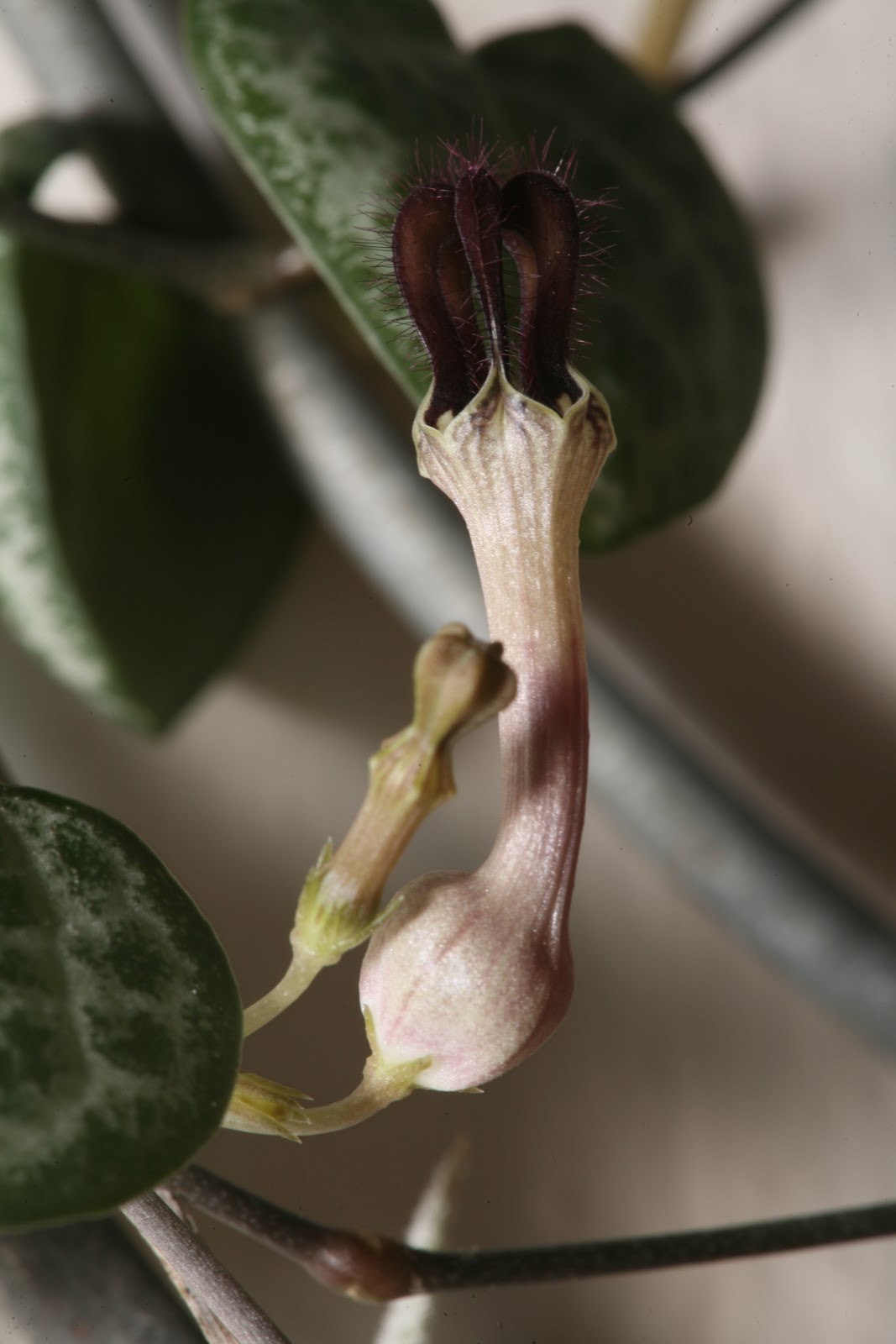
Our Ceropegia woodii (string-of-hearts vine) is currently flowering. This somewhat succulent creeper has very unusual looking flowers. It's a rather amusing coincidence that the string of hearts is blooming for V-Day...!
Hairy Ceropegia woodii flower
Click for larger image
Creepy Hairs!
The flowers are unusual tubular structures, topped with hairy spires. It's experienced a surge in growth lately, mainly due, I think, to being loved a lot more (i.e. getting more regular waterings). Just to add to the V-Day theme, this plant is being trained around a wire heart...

Not forgetting this is Orchids on a Balcony, here's a close up of a flower from our Zygopetalum James Strauss:
Zygopetalum James Strauss 1:1 macro

Thursday, February 3, 2011

Mystery Orchid

Phalaenopsis NOID - gift.
A mystery orchid of a slightly different kind landed on my chair on Friday (or possibly earlier). Came back to the office to drop some things off after a 2 day out-of-town brainstorming meeting to find a double stemmed Phalaenopsis hybrid sitting in my bin on my chair (after 5, so everyone was already home).

We spent the weekend wondering where it had come from, not sure if it was a gift, or a mystery guest or a "not too sure if this is happy, please look at it" kind of vibe.

On Monday, I found out one of my colleagues had bought it for me as a "Thank you" for building and installing a PC for them a few months ago - mystery solved. Many thanks Helen! I'll take some close up pictures soon; it's currently tied down to the rack at OOAB HQ, as it's so top-heavy that it's always threatening to come crashing down.

Wednesday, February 2, 2011

Epic Fail.

I was going to have a blog post about just how well our Slc Kagaribi Dawn 'Red Star' was doing in the next few days. As well as the two flowers blogged in the first post, it had first shown signs of 2 more flower buds, then 3 and now 4!

Then, this morning, I thought I'd help the flowers to present a little better; one of the buds (the newest and closest to the main stem) was folded on top of the leaf; I decided it would look better under the leaf. So I tried gently persuading it to go there.

Snap

Drop

Gasp.

Looks like they're a lot less pliable that you would think. I had previously persuaded the other blooms to move into a new position (above the leaf) - but they were older and I guess the stems were longer and more pliable.

So this morning, I managed to snap what would have been 4 perfect blooms right off. Like an idiot :/

Sadness.

Warning: Much sadness below.

You can just about make out the buds on this shot from a couple of days ago,
on the stem at the left behind the flowers.
NOOOOOOOOOOOOOO!!!!!!!!!!!!!!!!!!!!!!!!!!!!!!!!
Once had flowers. 4 of them. Moments ago. :(
:(
Surely I can just push it back? No.
Fantastic Flowers. Could have had 6 :/
I tried "grafting" it back on, but it was impossible, there wasn't enough stalk, and the buds were so heavy they kept on pulling apart from the rest of the plant. And the wound started to go brown and "scab" very quickly, so I had to give up.

As they say on the Internets... EPIC FAIL. :(

Arghh.

Two days of "bad luck" at OOAB.

Edit:

In a related note, Tinus from Plantae.co.za sent me a message about the blog (I put a link in to my my signature when I emailed him asking about an order):
Hi James

Had a look at the blog. It looks interesting. We are starting our own and it should be running soon.

About the plant you bought from Michael – the reason you cannot find it on the RHS register is because the name is incorrect. It should be Kagaribi Dawn. Hope you did not buy it with the incorrect name?

Regards

Tinus

So at least it looks like my diagnosis of what this plant's name should be is right. A rather tiny consolation!

Thursday, January 13, 2011

Paphiopedilums

We bought some Paphiopedilums at Exotic Plant Company. Much like the Zygopetalum, they didn't have too much information beyond their Genus name. I've written to them asking if they might have additional details on these three plants, fingers crossed! (Edit: they did, have added names).

The more fancy looking of the two paphs looks like this, and was originally grown by PP Orchideeën in the Netherlands:

Paphiopedilum (Bagley x insigne)


The other one is showy in a rather elegant, understated way, with mottled green leaves and flowers striped with green:

Paphiopedilum Onyx


Note the stripy leaves.
Paphiopedilum are classed as "semi-terrestrial" orchids; their potting mixes are generally a little finer and more water-retentive than those for true epiphytes. They generally grow quite low down in forests, often in leaf litter, in fairly shaded habitats, so they prefer quite low light as a general rule. Apparently they're generally quite happy as houseplants, preferring similar temperatures to us!