Showing posts with label diseases. Show all posts

Tuesday, February 1, 2011

Pests: Black Fly

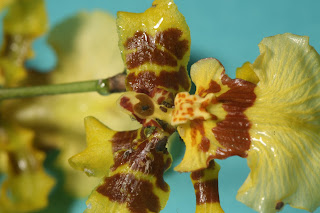
This morning whilst doing our watering we noticed a few black bugs crawling over the pseudobulbs on our Oncidium sphacelatum. Turns out "A Few" was actually Hundreds when we looked up at the racemes. Almost every flower has like 20-50 little black aphid type creatures clustered around it, merrily sucking away. No wonder the flowers were starting to look sad :/

Black Fly Of Doom
Lots of Doom
Not just behind, but in and on the flowers.
And look at those shed exoskeletons. :/

Extreme closeup (crop)
 The Oncidium was then immediately relegated to the bathroom (quarantine and spraying area), had the worst affected (and mostly dead) racemes trimmed off (tragic!), and was then sprayed with Dursban (Chlorpyrifos) 1ml/l with 1ml/l of Bladbuff wetting agent. Made sure some got into the crowns between the leaves, just in case...

I really, really would like a lot of lady bugs and whatever eats/parasitises whitefly and red spider mite...

So, if your flowers look sad, don't assume they're done flowering... have a closer look :/
We'll be keeping a close eye on the rest of our plants for the next couple of weeks.

The photographic models got flushed down the toilet, and the other racemes were tossed in a plastic bag and immediately removed from the OOAB premises... Argh.

Tuesday, January 25, 2011

More fungi...?

Our Rhychostylis coelestis seems to have some kind of fungus growing on a few of it's leaves. Yesterday, I decided enough was enough as it seemed to be spreading. I sterilised some scissors in something called "Grovisan", which is apparently similar to Physan. I then cut the three dodgy looking leaves off, dusted the ends of the cut with sulphur, and sprayed the whole plant with a fungicidal spray consisting of 1ml of Benlate, 1ml of Previcur and 1ml of a wetting agent called Bladbuff. I then re-dusted the ends of the cuts with sulphur, as the spray washed some of it away. I even dumped the dodgy leaves in Grovisan (and re-soaked the scissors) before tossing the leaves in the bin.

Here's what the dubious leaves looked like: 
Closeup of the worst affected leaf; this was "weeping" fluid just after I cut it.
Underneath the leaves.
Upper side of the leaves. Note the top one has a long "blister" spreading out from the dark spot.
This plant had some Captab or Dithane (4g/l WP; actual concentration 2g/l) - I can't recall which one was sprayed on it a few weeks ago, but that didn't seem to really stop it. We used to spray the leaves of all the plants a few times a day (never in the late afternoon/evening though) to "increase humidity" in the balcony, but I've decided this is a bad idea. We'll now just be spraying the exposed roots of the Ascocentrum and this Rhynchostylis rather than the whole plant. Hopefully, this will minimise the chances of any fungal or bacterial rots. With a mist humidifier, we should be able to keep the humidity in a range where the orchids will be happy without spraying the leaves with water. On really hot days, we may still spray whole plants, but we'll see how it goes!

I really really hope this is a fungus, not a bacterium, as those seem much harder to treat (and I don't think I have, or can easily get, anything that does).

Thursday, January 13, 2011

Disa Rot

Apparently the biggest problem with growing Disas is their susceptibility to fungi. How the little blighters ever manage to grow in the wild is a mystery!

One of the Disas we bought at La Motte was stricken with "Disa rot" whilst in our care, where some bacterium or (more commonly) fungus starts chomping away at the roots. Underground. Where you can't see it. The next thing you know, the leaves start turning yellow. We tried two doses of Efekto's Fungi Nil 500 WP (500g/kg Captab [Dicarboximide]) at 4g/l, but the plant looked more and more sad.

Last night, after potting up some flasked, micropropagated Disa bivalvata, I decided to have a look at the orchid underground and see how things were getting on.

I was dismayed to see just how far the rot had gone; pretty much all the above ground plants had rotted clean through where they join up to the roots/tubers - the flowering stem pretty much fell right off when I removed the plant from its pot. I managed to find one tiny shoot and tuber (with no intact roots) that looked like it might make it; everything else was blackened and had rotted right through. :(

Disa Rot: The surface signs
Disa Rot: Noooooo! My Plants!!!! :( You can see the tubers and the shoots and how it rots right through the middle.
Disa Rot: Up close and personal. Yuck!
Sad looking flowers; you'll note that the seed pod was swelling, so our efforts at pollination had worked. :(
All that remains... (the background is kitchen towel, so you can see just how small this was)
After leaving the tiny little plantlet soaking in fungicide for a while, I repotted it into fresh Disa potting mix and watered it with 4g/l Fungi Nil. Hopefully it will make it, but I don't hold out much hope :( Most Disa growers seem to recommend regular "preventative" anti-fungal treatments - looks like they're definitely needed...